 Edinburg Mobile Home Leveling
 Mobile Home Leveling in Edinburg, TX
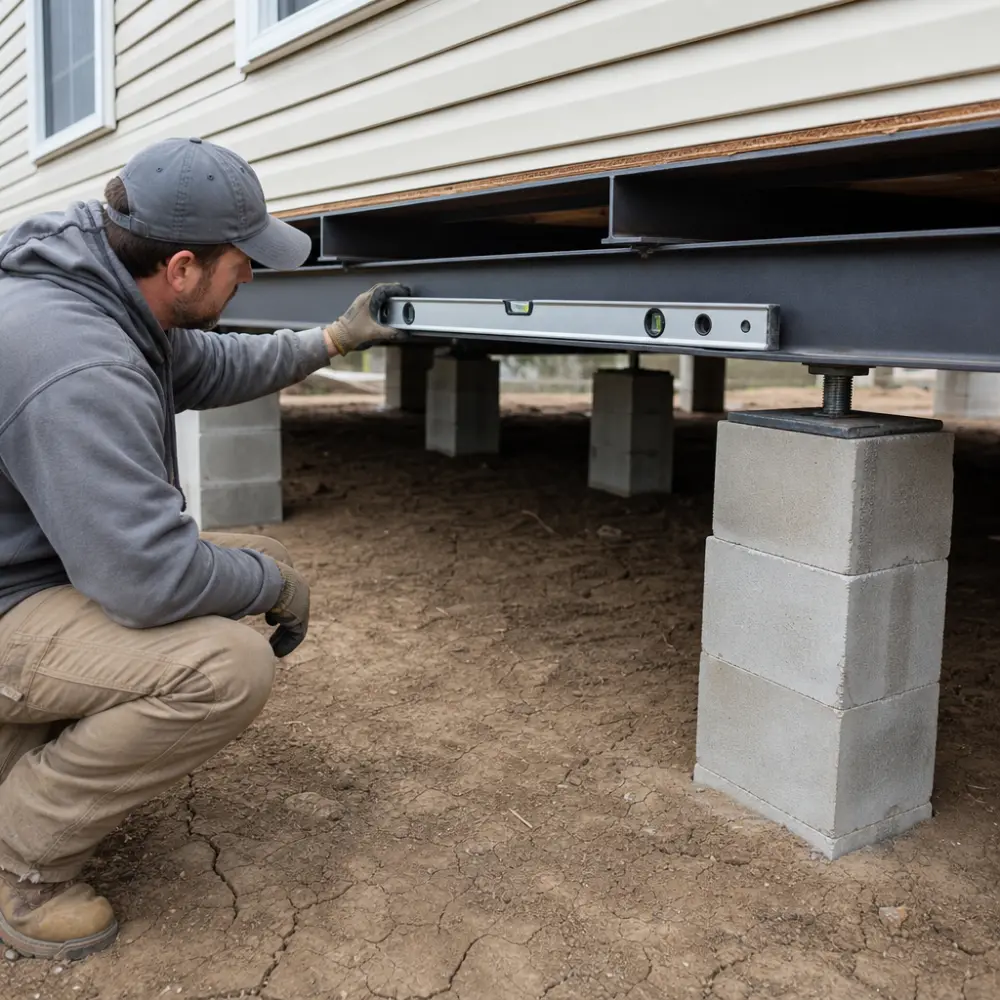
Mobile home leveling, releveling in the trade, is the job of bringing a settled manufactured home’s steel chassis back to flat and evenly supported. A crew maps every pier with a water level, lifts the low sections on hydraulic jacks carried by cribbing, rebuilds each dropped pier with fresh hardwood shims to the Texas installation standard, and re-shoots the whole frame to prove it. We arrange that work across Edinburg and Hidalgo County through licensed, insured Texas manufactured home installers. A singlewide relevel runs $450 to $800 and a doublewide $750 to $1,400, and the level check that tells you where your home stands is free.
Sticking doors, a hallway with a lean in it, a seam opening along the ceiling of a doublewide: those are the reasons people call, and in the Valley they trace back to what the ground does between a wet September and a dry June.
Why the ground under Hidalgo County moves
The county is not one kind of dirt. The USDA soil survey maps the Hidalgo series as the most extensive soil in the county, roughly 190,000 acres of it, and it is what sits under most of the higher ground around Edinburg, north McAllen, and north Mission. Hidalgo sandy clay loam is well drained with moderate permeability and a subsoil of 23 to 35 percent clay. It moves a little when wet, but its shrink-swell rating is low. A pier on it settles the ordinary way: the footing presses in, the wet side of the home drops faster than the dry side, and after a few years the frame is out of plane.
Go south toward the river or east toward Weslaco and the ground changes character. Harlingen clay, mapped south of Pharr and Alamo, runs 60 to 75 percent clay, and the official series description says its cracks “remain open from 150 to 210 cumulative days in most years,” with slickensides starting 20 to 30 inches down. Mercedes clay east of Weslaco is the same family. Raymondville clay loam north of San Juan cracks “3/4 inch to 2 inches wide” to depths of 30 to 40 inches when dry. Runn silty clay takes over south of Donna, Mission, and Weslaco toward the river. These are the soils that swell when they take on water and shrink hard when they lose it, and a block pier on a small footing rides that cycle up and down. It does not go up and down evenly, because the piers under a roof valley or a downspout get more water than the piers in the middle of the home. The uneven part is what racks the frame.
Then there is the water. McAllen’s 1991 to 2020 normals put September at 4.61 inches, the wettest month, right after an August that normals a 99.6 degree high and bakes the clay hard. The big events do not respect the averages: the June 2018 flood put 18.31 inches on a gauge west of Mission, and Hurricane Hanna in July 2020 left 18 inches to 4 feet of standing water east of Edinburg and around Mission. Ground that sat under water for a week shifts under every pier that stood in it.
The state’s installation rule says it plainly at 10 TAC 80.21(h): “Water build-up may cause shifting or settling of the foundation, dampness in the home, damage to siding and bottom board, buckling of walls and floors, delamination of floor decking and problems with the operation of windows and doors.” That sentence is the reason this business exists.
What settling looks like from inside
Doors that rub and stop latching, floors that slope or bounce, cracks over doorways, and on a doublewide a gap along the marriage line. If a marble travels the same way in every room the frame is low on that side; a single soft spot is more often a lost pier or a wet subfloor. Any one of those earns a free level check, because a pier an inch low today is grinding its own cap and will be lower after the next wet season.
What a relevel involves
The survey. Access panel off, crew under the home end to end, every pier shot with a water level off a datum pier. You get a number per pier. Pads, caps, and shim stacks get handled, the belly gets checked, and every anchor strap gets looked at for tension and rust. The written price comes out of this map, before anything is lifted.
The lift. Twenty-ton bottle jacks on solid wood cribbing at the frame near each low pier, working in small increments across several stations so the chassis comes back toward plane as a unit. Cranking one point far out of plane is what cracks drywall and pops trim. The rule that separates competent work from dangerous work: the cribbing carries the load, never the jack.
The pier work. Texas sets the limits in 10 TAC 80.23. Wedge shims go in from both sides of the I-beam, a minimum of 3 by 6 inches, and the shim stack “must not exceed 1 inch.” Including caps and plates, “a maximum of 4 inches of wood including shims” is allowed on top of a pier. A pier that has dropped further than that cannot be shimmed back inside the rule. It gets rebuilt at the right height, with a footing sized to the soil, and that is priced separately at $150 to $400 a pier and called out before it is done. End piers have to sit within 24 inches of the end of the main frame, which is a common miss on old setups.
The verification. The frame is re-shot end to end. Every pier has to be carrying load, which you confirm by hand, because a home can read level while standing on piers that are doing nothing. On a doublewide both halves have to read matched along the center row.
The straps. Raising the home changes the tension every strap was set at, so they get re-tensioned as part of the job. If the anchor system is short, corroded, or missing the end ties the state requires, you get told and it gets quoted separately rather than quietly added.
Who is allowed to do this in Texas
The Manufactured Housing Standards Act, Chapter 1201 of the Occupations Code, defines installation at Section 1201.003(13) to include “supporting, blocking, leveling, securing, anchoring,” and Section 1201.101(d) says a person may not act as an installer without an installer’s licence from the Texas Department of Housing and Community Affairs. Section 1201.361 requires the installer to hand you a written two-year warranty that the work met the department’s standards, which a handyman with a bottle jack cannot give you. How to check a licence before anyone touches the home is on our installer licence page.
What it costs
| Work | Typical range | Time on site |
|---|---|---|
| Relevel, singlewide | $450 to $800 | 3 to 5 hours |
| Relevel, doublewide | $750 to $1,400 | 6 to 8 hours |
| Triple-wide or severely out of level | Quoted from survey | 1 to 2 days |
| Pier reset or reshim | $75 to $150 per pier | Within the relevel |
| Pier rebuild, new footing, blocks, cap | $150 to $400 per pier | Within the relevel |
| Strap re-tension | Included |
Toward the low end: a home that dropped evenly and only an inch or so, sound caps, dry ground, room to work, a Winter Texan park lot with a proper pad. Toward the high end: a doublewide with the marriage line open, piers two inches down on one side, crushed caps, standing water after a wet week, or clearance so low the crew works on its back. Texas’s generic standard calls for 18 inches between the ground and the bottom of the floor joists, and plenty of older homes were set with less. The cost calculator puts a range on your home from these same numbers, and the pricing page explains every line.
When to call
Call when a second door starts sticking, when a marriage line gaps, or when a park office or a buyer asks for a level letter. After a flood year, call in the fall, before the clay dries and drops the piers a second time.
Crews run out of Edinburg along US 281 and I-2 to McAllen, Pharr, San Juan, Alamo, Donna, Weslaco, and Mission. Same published prices everywhere, and the level check is free.
Frequently Asked Questions
How much does it cost to relevel a mobile home in Edinburg?
Singlewides run $450 to $800 and doublewides $750 to $1,400 across Hidalgo County. What moves the number is how far the home has dropped, how many piers need a rebuild instead of new shims, and how much room there is under the frame. The level check is free and the written price comes before any jack goes under a beam.
How do you know which piers dropped?
A water level. The crew picks the most stable pier as a datum and reads every other pier against it, so each pier gets a number rather than an opinion. The readings go on a frame map that shows exactly where the home is low and by how much, and the quote comes from that map.
Will it need doing again?
On the clay side of the county, probably. Harlingen and Mercedes clays swell when wet and shrink when dry, and the state's own installation rule says water build-up under a home causes shifting and settling. Homes on the well-drained Hidalgo sandy clay loam around Edinburg tend to hold longer. Fixing drainage under the home stretches the interval; nothing makes it permanent.
Is a Texas licence required for this?
Yes. The Manufactured Housing Standards Act defines installation to include supporting, blocking, leveling, securing and anchoring, and Section 1201.101(d) says a person may not act as an installer without an installer's licence from the Texas Department of Housing and Community Affairs. Every crew arranged through us holds one, and you can check it on the TDHCA licence database before anyone lifts anything.